AIoT
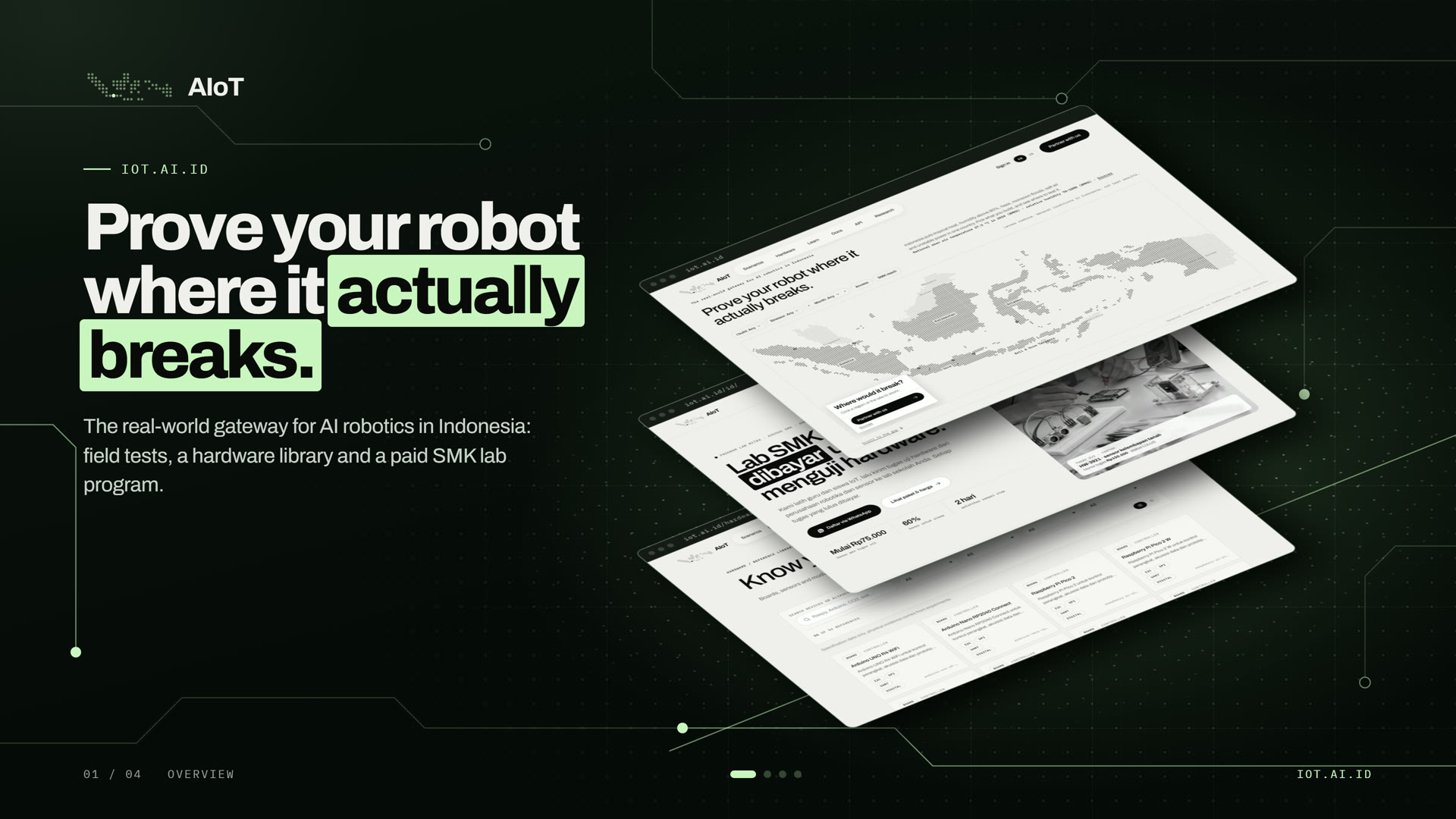
The real-world gateway for AI robotics in Indonesia, built as a public site plus an AI hardware workspace for ESP32.
- Client
- AIoT
- Role
- Year
- 2026
- Stack
- React 19, Vite 8, TypeScript 6, React Router 7, React Flow, Node 22+ API, Zod, Arduino CLI + arduino-mcp-server, Model Context Protocol, Electron desktop shell, Docker Compose, Playwright tests
Problem
Robots, sensors and IoT boards are designed for clean labs, then fail in tropical heat, 70-90% humidity, unstable power and patchy networks. Teams that want proof of how hardware behaves in Indonesia have nowhere to get it, and Indonesian vocational schools have talent and benches but no way to get paid for real work.
What the live site covers
- Home: an interactive dot-matrix map of Indonesia with sourced test conditions, field scenarios and the four-step verification loop (specify, deploy, execute, record). - Hardware library: 56 board, sensor and module references (ESP32, Arduino, Raspberry Pi, BME280, SSD1306 and more) with pinout, electrical limits and sources. Each page states whether firmware can actually run or whether it is a specification only. - Program Lab Mitra (Bahasa Indonesia): SMK school labs get trained in two days, then receive paid hardware test tasks from robotics and sensor companies. Published rates start at Rp75.000 per task and students receive 60% of the fee. Sign-up runs through WhatsApp. - Learn, Docs and Research: a guided "build, break, recover" ESP32 + BME280 + SSD1306 lesson, local runtime docs, and the evidence model. - Partner page: an inquiry form for device makers, schools and buyers.
Engineering idea
Integrate existing hardware tools first, invent only what is missing. A structured hardware contract is validated for pins, voltage and bus conflicts before any firmware exists. Evidence is identity-bound, and a simulated pass is never relabeled as a physical pass. The workspace (React Flow canvas, chat revisions, local compile and flash) is invitation-only and not part of the public captures.